

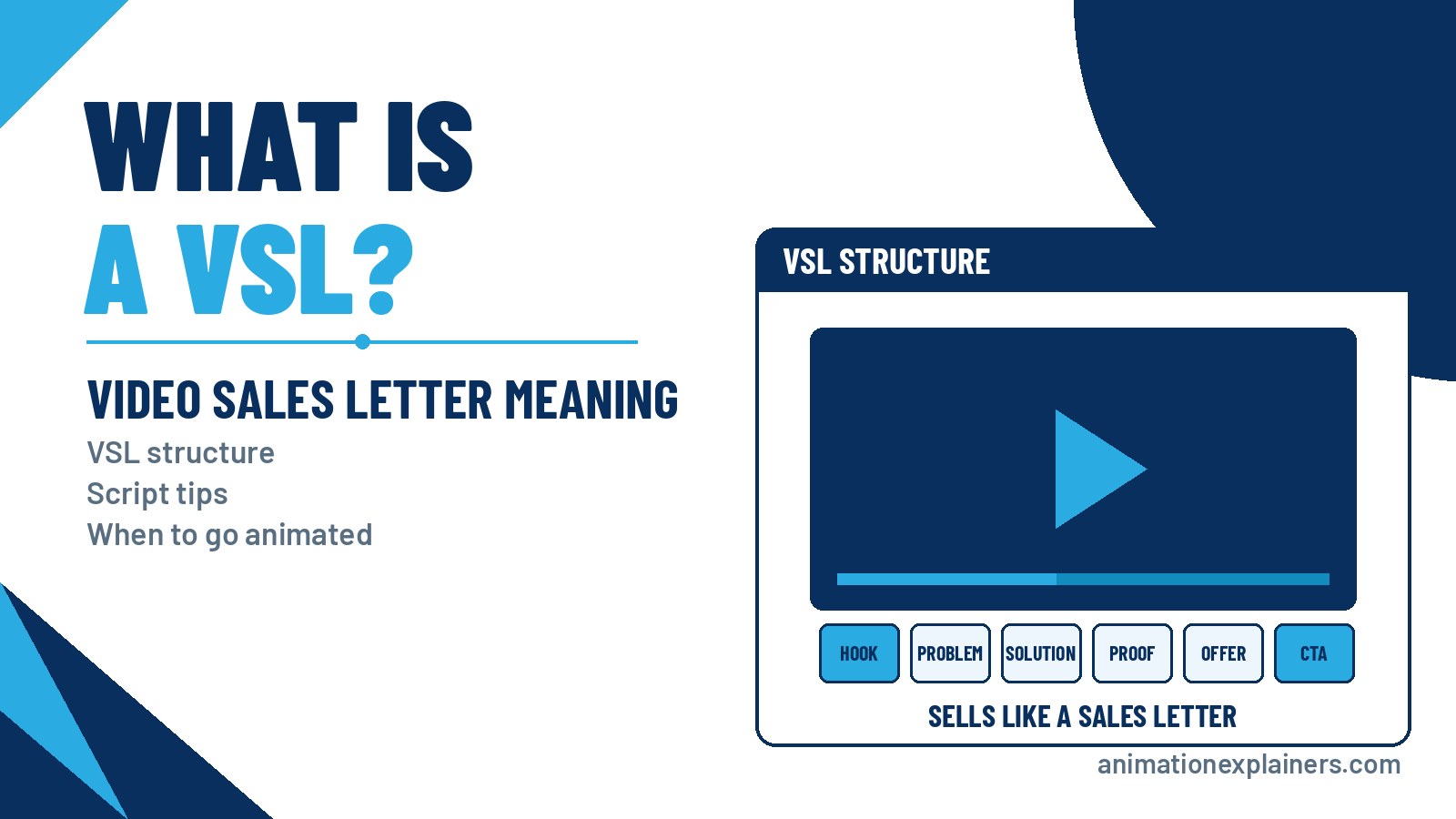
What Is a VSL? Video Sales Letter Meaning & How to Make One
VSL stands for video sales letter: a video that does the job of a written sales letter. It walks one viewer through a problem, your solution, proof and an offer, and ends with a single call to action. VSLs usually sit on a landing or sales page, often in place of most of the written copy.
If you’ve seen “VSL” in a funnel plan or a marketing brief and wondered what it means, this guide covers the meaning, how a VSL differs from an explainer video, a proven structure, script tips, the main formats and when an animated VSL makes sense.
What does VSL mean?
VSL = video sales letter. The name comes from the long-form direct-response sales letter, a written page that takes a reader from attention to purchase. A VSL turns that same persuasive sequence into a video, usually narrated, with visuals that reinforce each point.
The plural, VSLs, simply means several video sales letters, for example one per product, offer or audience.
In marketing, VSL almost always means video sales letter. Outside marketing the same letters stand for other things, which is why a search for “VSL meaning” can be confusing. In economics and public health, VSL is the value of a statistical life, used in cost-benefit analysis of safety rules. In traffic management, it’s a variable speed limit. In music software, it’s Vienna Symphonic Library, an Austrian maker of orchestral sample libraries.
Where the VSL came from
Before video, direct-response marketers sold by post with long sales letters: written pitches designed to sell without a salesperson in the room. Copywriters such as John Caples, Eugene Schwartz and Gary Halbert built their reputations on them. The best-known example is Martin Conroy’s “Two Young Men” letter for The Wall Street Journal, which ran from 1975 to 2003 and is estimated to have brought in around $2 billion in subscriptions.
A VSL keeps that letter’s persuasive sequence but delivers it as narrated video on a web page. One practical difference: on a written page, the reader can skip straight to the price, while in a video the viewer usually hears the argument in the order it was written. The written equivalent today is often called a text sales letter (TSL), and many sales pages use both: a VSL at the top with the key points repeated in copy below.
What is a VSL used for?
A video sales letter has one job: move a viewer to take a specific action. Typical uses include:
- Sales and landing pages, where the video carries the main pitch above the fold.
- Webinar or lead-magnet funnels, after someone signs up and is warm enough for an offer.
- Product launches, to explain a new offer and why now.
- Sales follow-up, sent after a call so the prospect can share the pitch internally.
- Paid ad destinations, where traffic lands cold and needs the full story.
VSL vs explainer video vs sales video
| Video sales letter (VSL) | Explainer video | Sales video | |
| Main goal | Get one action: buy, book or sign up | Help people understand a product or idea | Support the sales process |
| Typical length | Often longer, because it carries the whole pitch | Usually short, often 60–90 seconds | Varies by stage |
| Structure | Problem, solution, proof, offer, call to action | Problem, solution, how it works, call to action | Depends on use |
| Where it lives | Sales or landing page | Homepage, product pages, sales decks | Emails, decks, follow-ups |
In practice the lines blur. Many of our animated sales videos use explainer clarity with VSL structure.
How to structure a VSL
Most effective VSLs follow the same persuasive order as a classic sales letter:
- Hook. Call out the viewer and the problem in the first few seconds, so the right people keep watching.
- Problem. Describe the pain in the viewer’s own words, and what it costs them.
- Agitate. Show why the usual fixes don’t work, without exaggerating.
- Solution. Introduce your product or service as the answer.
- How it works. Show the mechanism simply, so the promise feels believable.
- Proof. Use real results, testimonials, client logos or demos you’re allowed to show.
- Offer. Spell out what they get, the price or next step, and any guarantee.
- Objections. Answer the two or three reasons people hesitate.
- Call to action. One clear next step, repeated on the page next to the video.
How to write a VSL script
- Write for one viewer. Use “you”, short sentences and the language your customers use.
- Lead with the problem, not the company. Nobody cares about your founding story until they care about the problem.
- Make every claim provable. If you can’t back a result with evidence, cut it. Regulated industries need extra care.
- Read it aloud. If you trip over a line, the voiceover will too.
- Plan the visuals with the words. Each key point needs something on screen that makes it clearer.
- Borrow a proven formula. Classic copywriting frameworks map neatly onto a VSL. AIDA is attention, interest, desire, action. PAS is problem, agitate, solution. Pick one as the spine of your first draft.
For a full process and template, see our guide on how to write a video script.
How long should a VSL be?
There’s no single right length. A VSL needs to be long enough to cover the problem, the solution, the proof and the offer for your audience, and no longer.
What changes the length most is the price and complexity of the offer, and how well the viewer already knows you:
| Situation | Typical approach |
| Classic direct-response offers to cold traffic (supplements, courses, info products) | Long-form VSLs, often 10 minutes or more and sometimes 30 to 45 minutes, because the video has to build all the trust itself |
| Lower-priced or simpler offers | A short-form VSL of a few minutes, with the same structure compressed |
| Business (B2B) offers, follow-up and warm audiences | Usually a few minutes at most; the VSL frames the offer and moves people to the next step, such as booking a call |
| Ads and email | Short cut-downs of the main VSL that send people to the full version |
A cold audience buying something complex usually needs more explanation than a warm audience who already knows you. Test shorter cuts too: a full-length VSL for the sales page and short edits for ads and email. For explainer-style runtimes, see how long an explainer video should be.
Types of VSL
| Format | What it looks like | Good for |
| Text-on-screen (slide) VSL | Words appear on screen in sync with the voiceover | Low-budget tests and copy-led offers |
| Talking-head VSL | A founder or presenter speaks to camera | Personal brands, coaching and services |
| Screen-recording VSL | Software walkthrough with narration | SaaS and digital products |
| Animated VSL | Custom 2D or 3D animation with voiceover | Complex, technical or regulated offers |
| Hybrid VSL | Presenter footage combined with animation | Blending trust with clear explanation |
Why choose an animated VSL?
Animation makes it easier to show things a camera can’t: how software works under the hood, a medical mechanism, a financial process or a before-and-after. It also keeps the brand look consistent, and individual scenes can be updated later without a reshoot.
The trade-off is production time and cost compared with a slide or talking-head VSL. For a high-traffic sales page or a complex offer, that investment is often worth it. At Animation Explainers, custom animated videos typically fall between $6,000 and $35,000+, depending on length, style and scope; see our explainer video cost guide.
Here’s a short example: a 30-second direct-response film we made for Ibotta. It opens with a hook (“Have you seen the price of gas?”), makes the offer, explains the steps and ends with a clear call to action.
VSL mistakes to avoid
- A slow start. If the first seconds don’t name the viewer’s problem, they leave.
- Hype without proof. Big promises with no evidence damage trust, and can create compliance risk.
- Too many calls to action. One next step converts better than three options.
- No captions. Many people watch with the sound off; add captions.
- The video does everything. Put the key points and the call to action on the page as well, for people who won’t press play.
How to tell if your VSL is working
Most video hosts and landing-page tools report a few numbers that tell you where a VSL is winning or losing people:
- Play rate: the share of page visitors who press play. If it’s low, look at the thumbnail, the headline above the video and where the video sits on the page.
- Watch time and drop-off: how far people get. A sharp drop at one point usually means that section is slow, confusing or off-message, so rewrite or cut it.
- Conversion rate: the share of viewers who take the call to action. If people watch to the end but don’t act, look at the offer, the proof and the call to action itself.
- Cost per acquisition: what you spend on traffic for each sale or lead. This is what tells you whether the VSL pays for itself.
Change one thing at a time, such as the hook, the proof or the offer, so you know what made the difference.
How to get a VSL made
Bring your offer, your audience, the proof you can use and where the video will run. We’ll help shape the script structure, choose a style, cast the voiceover and produce a VSL that fits your funnel. Book a call with Animation Explainers to talk it through.
FAQ
What does VSL stand for?
VSL stands for video sales letter: a video version of a written sales letter that takes a viewer from a problem to an offer and one call to action.
What else can VSL mean?
Outside marketing, VSL can mean the value of a statistical life (economics and public health), a variable speed limit (traffic management) or Vienna Symphonic Library (music software). In sales and marketing, it means video sales letter.
What is a VSL in marketing?
In marketing, a VSL is a persuasive video, usually on a sales or landing page, that presents a problem, a solution, proof and an offer, then asks the viewer to take one action, such as buying, booking a call or signing up.
What is the difference between a VSL and an explainer video?
An explainer video’s main job is understanding: what a product is and how it works. A VSL’s main job is action: it carries the full sales pitch, including the offer and objections. Many good VSLs borrow explainer-style clarity.
How long should a VSL be?
Long enough to cover the problem, solution, proof and offer for your audience, and no longer. Classic direct-response VSLs for cold traffic often run 10 minutes or more, while business VSLs for warm audiences are usually a few minutes. Test shorter cuts for ads and email.
What’s the difference between a VSL and a TSL?
A VSL (video sales letter) delivers the pitch as a video; a TSL (text sales letter) delivers the same sequence as a written page. Readers can skim a TSL and jump to the price, while a VSL presents the argument in order. Many sales pages combine both.
What should a VSL script include?
A hook, the problem, why other fixes fail, your solution, how it works, proof, the offer, answers to common objections and one clear call to action.
Can a VSL be animated?
Yes. Animated VSLs are useful when the offer is complex or technical, or when you want a consistent brand look that can be updated later without reshooting.
How much does an animated VSL cost?
At Animation Explainers, custom animated videos typically cost between $6,000 and $35,000+, depending on length, style and scope. We quote against your brief.
Can Animation Explainers make a VSL for my business?
Yes. We write, design, voice and animate VSLs for businesses. Book a call and tell us about your offer and audience.

What does VSL stand for?
VSL stands for video sales letter: a video version of a written sales letter that takes a viewer from a problem to an offer and one call to action.
What else can VSL mean?
Outside marketing, VSL can mean the value of a statistical life (economics and public health), a variable speed limit (traffic management) or Vienna Symphonic Library (music software). In sales and marketing, it means video sales letter.
What is a VSL in marketing?
In marketing, a VSL is a persuasive video, usually on a sales or landing page, that presents a problem, a solution, proof and an offer, then asks the viewer to take one action, such as buying, booking a call or signing up.
What is the difference between a VSL and an explainer video?
An explainer video’s main job is understanding: what a product is and how it works. A VSL’s main job is action: it carries the full sales pitch, including the offer and objections. Many good VSLs borrow explainer-style clarity.
How long should a VSL be?
Long enough to cover the problem, solution, proof and offer for your audience, and no longer. Classic direct-response VSLs for cold traffic often run 10 minutes or more, while business VSLs for warm audiences are usually a few minutes. Test shorter cuts for ads and email.
What’s the difference between a VSL and a TSL?
A VSL (video sales letter) delivers the pitch as a video; a TSL (text sales letter) delivers the same sequence as a written page. Readers can skim a TSL and jump to the price, while a VSL presents the argument in order. Many sales pages combine both.
What should a VSL script include?
A hook, the problem, why other fixes fail, your solution, how it works, proof, the offer, answers to common objections and one clear call to action.
Can a VSL be animated?
Yes. Animated VSLs are useful when the offer is complex or technical, or when you want a consistent brand look that can be updated later without reshooting.
How much does an animated VSL cost?
At Animation Explainers, custom animated videos typically cost between $6,000 and $35,000+, depending on length, style and scope. We quote against your brief.
Can Animation Explainers make a VSL for my business?
Yes. We write, design, voice and animate VSLs for businesses. Book a call and tell us about your offer and audience.
